


Hey, it's Mike Geary from TruthAboutAbs.com
I told you last week that I'd be sending you out a training challenge this week.
Well, here it is. I challenge you to try to beat my results at this little 5-minute routine.
You'll see my results below.
 I'm sure if you've been reading my
info for some time that you know I like to get creative in the training
routines that I recommend trying. I think trying different training
styles and routines keeps things more interesting and can be motivating
if you set specific goals for certain exercises.
I'm sure if you've been reading my
info for some time that you know I like to get creative in the training
routines that I recommend trying. I think trying different training
styles and routines keeps things more interesting and can be motivating
if you set specific goals for certain exercises.
In fact, if you didn't already see it, one of my unique training ideas was recently featured in the popular international magazine, Muscle & Fitness Hers, Jul/Aug issue pg. 18.
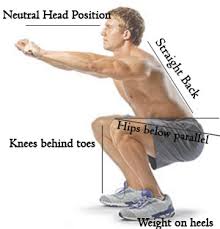
So my boredom buster this week is something I just thought up recently. I set a challenge with a couple of my training partners at my gym to see who could do the most repetitions of bodyweight squats in 5 minutes. I will qualify that these are meant to be full squats all the way down to thighs parallel with the ground, not the little "half way down" squats that you see so many people doing.
You basically just keep squatting for as many reps as possible in 5-min. You only rest a couple times here and there for a few seconds if you need it to help you keep squatting.
I liked this idea because I thought it would be drastically different from the normal 3 sets of 10, 5 sets of 5, 7 sets of 3, and so on. No matter how you break it down with weighted squats, you're usually in the range of 20-40 total repetitions in a given workout.
However, with max repetition bodyweight squats in 5-minutes, your numbers easily can get up to well over 100 reps. Let me tell you... even though you're not squatting heavy weights with this unique training style, the high volume of repetitions really pumps your legs and gets you dripping with sweat. Also, if you're not used to this high volume, your legs will be in for some deep soreness for about 2-3 days afterwards.
 So the results? Well, in my first
attempt at 5-minute squats, I pumped out 157 reps. About a week later, I
tried it again, and beat my 1st number by repping 163 squats. Then the
following week, I once again beat my former scores by blasting through
169 squats.
So the results? Well, in my first
attempt at 5-minute squats, I pumped out 157 reps. About a week later, I
tried it again, and beat my 1st number by repping 163 squats. Then the
following week, I once again beat my former scores by blasting through
169 squats.
I've set the goal that I'd like to get up to 200 squats within the 5-minute time frame. Considering that you have 300 seconds in 5-minutes, I figured 200 reps might be about at the maximum possible capacity as you really need to be repping quickly to do 200 parallel squats in 300 seconds.
Anyway, you can see that this is just one of the many quirky training challenges that I think up on a regular basis that keeps me interested and keeps things fresh. It's a good idea to pick a goal like this and work towards it for a month or two and then pick something totally different and work towards that for a month or two. This gives your body some good variety while also allowing for progression because of the short term consistency.
For example, this muscular endurance goal of 200 squats in 5-minutes is on the totally opposite end of the spectrum when compared to a different goal that I trained for last year when I was training in a pure strength mode working up to a 405-lb deadlift. Changing things up like this and training for wildly different goals at different times can really help keep you interested in your workouts.
Alright, so go ahead and give this little 5-minute squat challenge a try (remember full squats, no halvsies).
Update: several weeks after running this article, I ended up beating my goal of 200 bodyweight squats in 5 minutes by pumping out 214 reps! Oh my, the burn!!
Good luck!
Feel free to share this link to any friends, training partners, or family that you think might want to try this training challenge.
Mike Geary
Certified Personal Trainer
Certified Nutrition Specialist
Founder - TruthAboutAbs.com
I told you last week that I'd be sending you out a training challenge this week.
Well, here it is. I challenge you to try to beat my results at this little 5-minute routine.
You'll see my results below.
In fact, if you didn't already see it, one of my unique training ideas was recently featured in the popular international magazine, Muscle & Fitness Hers, Jul/Aug issue pg. 18.
So my boredom buster this week is something I just thought up recently. I set a challenge with a couple of my training partners at my gym to see who could do the most repetitions of bodyweight squats in 5 minutes. I will qualify that these are meant to be full squats all the way down to thighs parallel with the ground, not the little "half way down" squats that you see so many people doing.
You basically just keep squatting for as many reps as possible in 5-min. You only rest a couple times here and there for a few seconds if you need it to help you keep squatting.
I liked this idea because I thought it would be drastically different from the normal 3 sets of 10, 5 sets of 5, 7 sets of 3, and so on. No matter how you break it down with weighted squats, you're usually in the range of 20-40 total repetitions in a given workout.
However, with max repetition bodyweight squats in 5-minutes, your numbers easily can get up to well over 100 reps. Let me tell you... even though you're not squatting heavy weights with this unique training style, the high volume of repetitions really pumps your legs and gets you dripping with sweat. Also, if you're not used to this high volume, your legs will be in for some deep soreness for about 2-3 days afterwards.
I've set the goal that I'd like to get up to 200 squats within the 5-minute time frame. Considering that you have 300 seconds in 5-minutes, I figured 200 reps might be about at the maximum possible capacity as you really need to be repping quickly to do 200 parallel squats in 300 seconds.
Anyway, you can see that this is just one of the many quirky training challenges that I think up on a regular basis that keeps me interested and keeps things fresh. It's a good idea to pick a goal like this and work towards it for a month or two and then pick something totally different and work towards that for a month or two. This gives your body some good variety while also allowing for progression because of the short term consistency.
For example, this muscular endurance goal of 200 squats in 5-minutes is on the totally opposite end of the spectrum when compared to a different goal that I trained for last year when I was training in a pure strength mode working up to a 405-lb deadlift. Changing things up like this and training for wildly different goals at different times can really help keep you interested in your workouts.
Alright, so go ahead and give this little 5-minute squat challenge a try (remember full squats, no halvsies).
Update: several weeks after running this article, I ended up beating my goal of 200 bodyweight squats in 5 minutes by pumping out 214 reps! Oh my, the burn!!
Good luck!
Feel free to share this link to any friends, training partners, or family that you think might want to try this training challenge.
Mike Geary
Certified Personal Trainer
Certified Nutrition Specialist
Founder - TruthAboutAbs.com


